
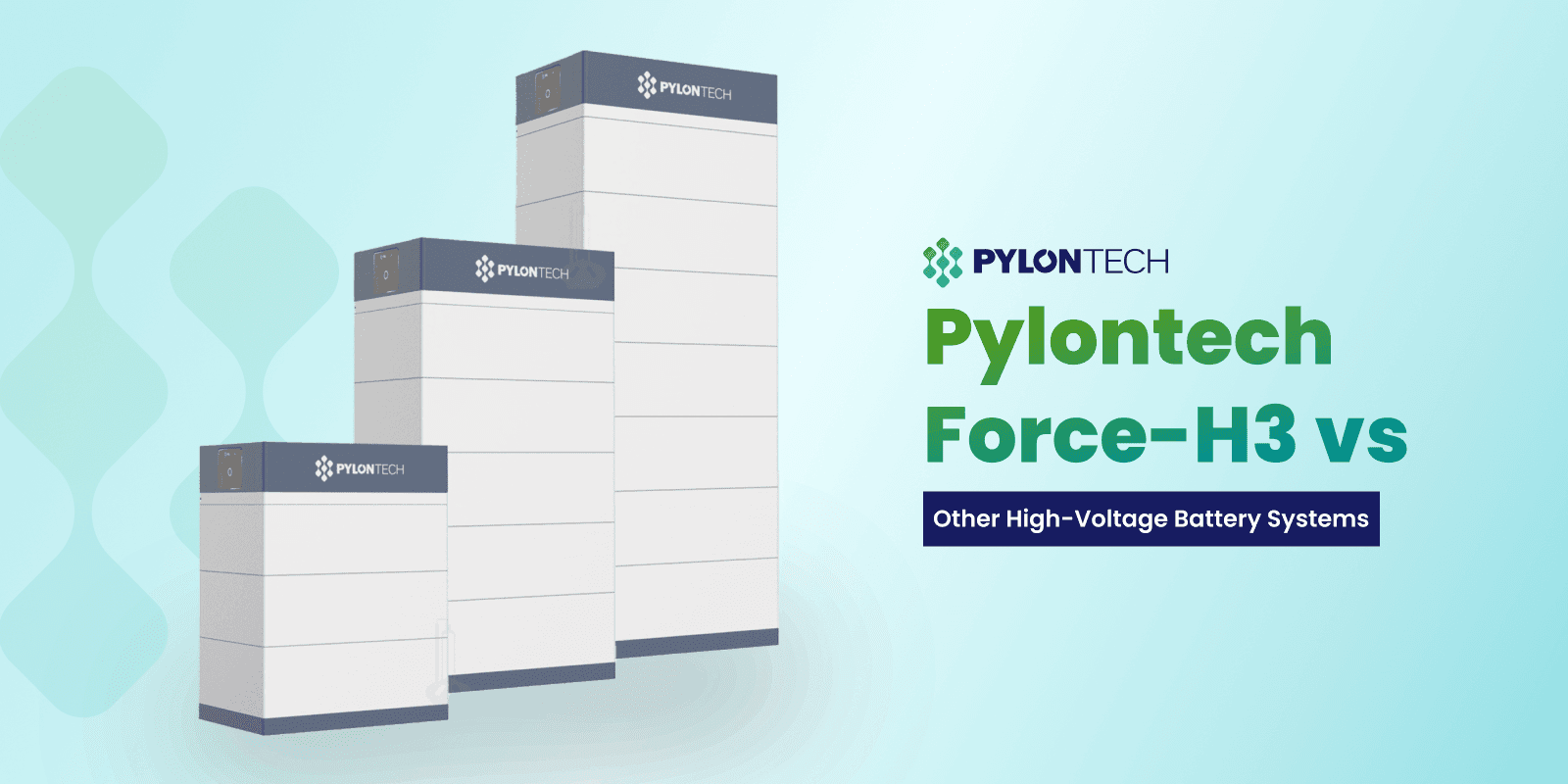
As solar adoption continues to grow, battery storage is becoming an important part of modern energy systems. A solar battery can store excess electricity generated during the day and make it available when solar production is lower, helping households and businesses make greater use of their solar energy.
Among the available options, high-voltage battery storage systems offer an efficient way to integrate energy storage with compatible solar inverters. One notable solution is the Pylontech Force-H3, a stackable lithium iron phosphate (LFP) battery system designed for residential energy storage.
But how does Force-H3 compare with other high-voltage battery systems, and what should you consider before choosing one?
What Is High-Voltage Battery Storage?
High-voltage battery systems operate at higher DC voltage than many traditional low-voltage battery systems.
In a solar-plus-storage installation, the battery works alongside a compatible inverter to store and supply electricity according to the system’s configuration.
A high-voltage design can offer several potential advantages, including:
- Efficient power transfer
- Compatibility with high-voltage hybrid inverters
- Scalable energy storage
- Flexible system configurations
- Suitable integration with modern solar installations
However, voltage alone should not determine which battery is right for your project. Capacity, chemistry, scalability, inverter compatibility, warranty, safety certifications and installation requirements should all be considered.
Introducing the Pylontech Force-H3
The Pylontech Force-H3 is a high-voltage, stackable LFP battery energy storage system. Its modular design allows capacity to be configured by stacking battery modules.
The Force-H3 uses 5.12 kWh battery modules, with configurations listed from two to seven modules per stack. This provides nominal system capacities from 10.24 kWh to 35.84 kWh in the standard configuration.
The system also supports multiple groups in parallel, providing additional flexibility for larger storage requirements.
Key Force-H3 Features
High-voltage architecture
Force-H3 is designed as a high-voltage energy storage solution for compatible systems.
LFP battery chemistry
The system uses lithium iron phosphate technology, a widely used chemistry for stationary energy storage.
Modular and stackable design
Its modular architecture allows the storage capacity to be configured according to the system requirement.
Up to 95% depth of discharge
The published specifications list a 95% depth of discharge for the standard Force-H3 configuration.
Long cycle life
Published specifications state more than 8,000 cycles under specified test conditions. Actual battery performance will depend on operating conditions and installation.
Communication and monitoring
Force-H3 supports communication interfaces including CAN and Modbus RTU for compatible system integration.
Pylontech Force-H3 vs Other High-Voltage Battery Systems
There is no single battery system that is best for every application. The right choice depends on the solar system, inverter, energy consumption and storage objectives.
Here’s how to compare Force-H3 with other high-voltage battery solutions.
| Feature | Pylontech Force-H3 | Other High-Voltage Systems |
|---|---|---|
| Battery chemistry | LFP | Depends on manufacturer |
| System architecture | High-voltage | High-voltage |
| Design | Modular & stackable | Varies |
| Module capacity | 5.12 kWh | Varies |
| Standard stack capacity | 10.24–35.84 kWh | Varies |
| Scalability | Multiple configurations | Depends on system |
| Depth of discharge | Up to 95% | Varies |
| Communication | CAN / Modbus RTU | Depends on manufacturer |
| Inverter compatibility | Compatible systems only | Depends on manufacturer |
| Cycle life | >8,000 cycles under specified conditions | Varies |
The comparison highlights an important point: battery specifications should always be assessed against the complete solar-plus-storage system, rather than comparing one specification in isolation.
1. Modular Capacity for Different Energy Requirements
One advantage of the Force-H3 design is its modular structure.
Instead of relying on a single fixed-capacity battery, the system can be configured using multiple battery modules. Standard Force-H3 configurations range from 10.24 kWh to 35.84 kWh per stack.
This can make the system suitable for different household energy-storage requirements.
For example:
Smaller energy requirement → Smaller battery configuration
Higher energy requirement → Larger battery configuration
The appropriate capacity should be determined based on actual electricity consumption, solar generation and the intended operating strategy.
2. LFP Chemistry
Battery chemistry is another important consideration when comparing solar battery storage solutions.
Force-H3 uses lithium iron phosphate (LFP) technology.
LFP is commonly used in stationary energy storage because of its combination of cycle-life characteristics and thermal stability.
When comparing different batteries, homeowners and businesses should look beyond chemistry alone and also consider the manufacturer’s specifications, safety certifications, warranty and installation requirements.
3. High-Voltage Architecture
High-voltage battery systems can be paired with compatible high-voltage hybrid inverters to create an integrated energy-storage solution.
Force-H3 configurations use system voltages ranging from 204.8 V to 716.8 V in the standard two-to-seven-module configurations.
This high-voltage architecture is one of the key differences between Force-H3 and many low-voltage battery systems.
However, compatibility is essential. A battery should only be installed with an inverter and system architecture approved for that battery.
4. Flexible System Expansion
Energy requirements can change over time.
A household may initially install solar and battery storage to reduce grid electricity consumption, then later require additional storage because of:
- Increased household electricity use
- Electric vehicle charging
- New appliances
- Greater evening energy consumption
- Expansion of the solar system
Force-H3’s modular approach can provide flexibility when designing a system around changing storage requirements. Pylontech documentation also describes multi-string operation for additional system flexibility. Make an informed choice with Achievers Energy! Reach out today.


