
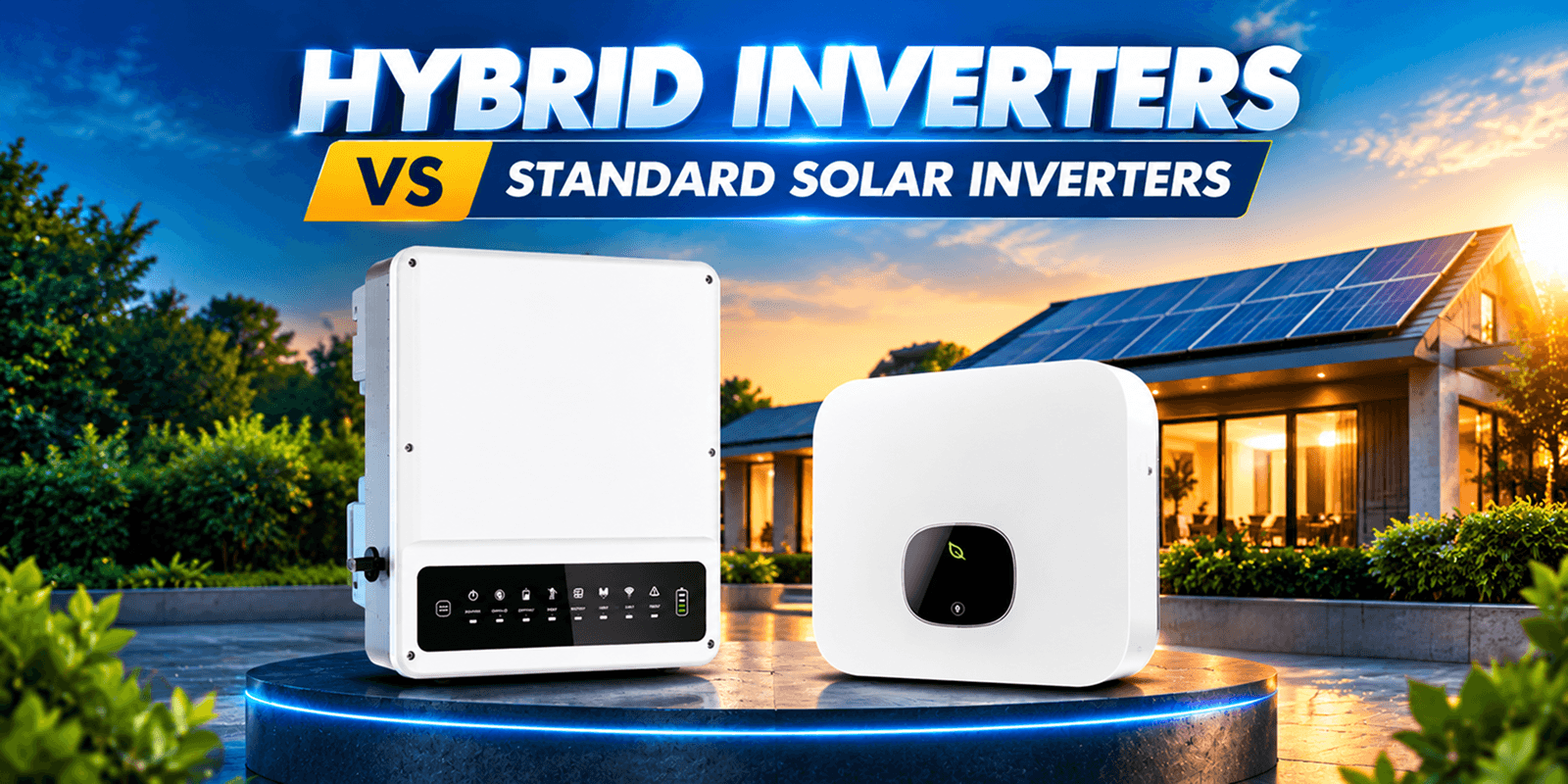
Solar inverters are a critical part of any solar power system. They convert the DC electricity generated by solar panels into AC electricity that can be used by homes and businesses.
However, not all inverters are designed to work in the same way. Standard solar inverters are primarily designed to convert solar power for use in a grid-connected system, while hybrid inverters can combine solar generation with battery storage and grid power management.
Understanding the difference can help homeowners, installers and businesses choose the right inverter for their energy requirements.
What Is a Standard Solar Inverter?
A standard solar inverter, often referred to as a grid-tied or on-grid inverter, converts the DC electricity generated by solar panels into AC electricity.
The basic energy flow is:
Solar Panels → Standard Solar Inverter → Home/Business → Grid
During the day, solar electricity can be used to power electrical loads. If the solar system produces more electricity than is being consumed, the excess may be exported to the grid, subject to the applicable electricity arrangement.
A standard solar inverter is generally suitable for customers who want to generate solar electricity and reduce their reliance on grid-supplied power without necessarily adding battery storage.
Key characteristics
- Converts solar DC power into usable AC power
- Designed primarily for grid-connected solar systems
- Generally does not directly manage a battery
- Can allow excess solar energy to be exported to the grid
- Suitable for many residential and commercial solar installations
What Is a Hybrid Inverter?
A hybrid inverter combines the functions of a solar inverter and battery inverter within a single system.
It can manage electricity from multiple sources, such as:
- Solar panels
- Battery storage
- Grid electricity
- Household or commercial loads
A simplified energy flow can look like:
Solar Panels → Hybrid Inverter → Home/Business
and:
Solar Panels → Hybrid Inverter → Battery
and, when required:
Battery → Hybrid Inverter → Home/Business
Depending on the specific model and system configuration, a hybrid inverter may also provide backup power functionality.
This makes hybrid inverters particularly useful for customers planning to integrate a solar battery storage system.
Hybrid Inverters vs Standard Solar Inverters
The main difference is their ability to manage energy storage.
| Feature | Standard Solar Inverter | Hybrid Inverter |
|---|---|---|
| Solar power conversion | Yes | Yes |
| Grid connection | Yes, for grid-tied models | Yes |
| Battery integration | Generally not built in | Yes |
| Battery charging management | No | Yes |
| Battery discharge management | No | Yes |
| Energy management | Solar-focused | Solar + battery + grid |
| Backup capability | Generally unavailable | Available on compatible systems |
| Suitable for future battery addition | May require additional equipment | Designed with battery integration in mind |
| System complexity | Generally simpler | More integrated |
The exact functionality varies by inverter manufacturer and model, so specifications should always be checked before selecting a system.
How Do Standard Solar Inverters Work?
A standard solar inverter primarily manages the conversion of electricity generated by the solar panels.
For example, during the day:
Solar panels generate DC electricity
↓
Inverter converts DC to AC
↓
Home or business uses the electricity
↓
Excess electricity may be exported to the grid
This can be a straightforward and effective approach for properties that do not require battery storage.
However, solar generation and electricity consumption do not always occur at the same time.
For example, a home may generate significant solar power around midday but use considerably more electricity in the evening.
Without battery storage, excess daytime generation may be exported rather than stored for later use.
How Do Hybrid Inverters Work?
Hybrid inverters add energy storage management to the solar system.
During periods of solar generation, the inverter can direct electricity according to the system’s configuration.
For example:
Solar generation → Household loads
Excess solar → Battery
When solar generation decreases:
Battery → Household loads
Grid electricity can supplement the system when required.
This ability to coordinate solar generation and battery storage is one of the key hybrid inverter benefits.
Key Benefits of Hybrid Inverters
1. Battery Storage Integration
One of the biggest advantages of hybrid inverters is their ability to integrate with compatible battery systems.
Instead of installing separate equipment for solar conversion and battery management, a hybrid inverter can provide these functions within one integrated system.
This can simplify system architecture and provide a more coordinated approach to energy management.
2. Better Use of Excess Solar Energy
Solar panels often generate electricity during the day when household electricity consumption may be relatively low.
A hybrid system can direct suitable excess solar energy into a battery for later use.
For example:
Daytime:
Solar → Home → Excess → Battery
Evening:
Battery → Home
This can increase the amount of solar energy used within the property rather than relying solely on grid electricity when solar generation falls.
3. Greater Energy Management Flexibility
Hybrid inverters can manage different energy sources depending on the system configuration.
This can give homeowners and businesses greater flexibility in deciding how solar generation, battery storage and grid electricity are used.
4. Potential Backup Power
Some hybrid inverter systems can provide backup power during a grid outage when paired with the appropriate battery and backup configuration.
However, backup functionality is not automatically available on every hybrid inverter.
The inverter, battery, backup equipment and electrical installation must all support the intended backup configuration.
5. Future-Ready System Design
A hybrid inverter can be useful for customers who want solar today but expect to add battery storage later.
Instead of replacing the inverter when adding a battery, a compatible hybrid system may allow the battery to be integrated into the existing setup.
This should be planned from the beginning, as inverter capacity and battery compatibility are important considerations.
When Is a Standard Solar Inverter a Better Choice?
A standard solar inverter may make sense when:
- The property has a reliable grid connection
- The primary goal is solar generation
- Battery storage is not currently required
- The customer wants a simpler system
- The property’s electricity consumption aligns well with daytime solar generation
For example, a commercial business that operates primarily during daylight hours may be able to use a significant portion of its solar generation directly.
In such cases, a standard solar inverter may provide an appropriate solution.
When Should You Consider a Hybrid Inverter?
A hybrid inverter may be worth considering when:
- You want to add battery storage
- Your electricity consumption is high in the evening
- You want to increase solar self-consumption
- Backup power is important
- You want greater flexibility in managing energy
- You expect your energy requirements to grow
For homeowners, a hybrid system can be particularly useful when the property’s electricity consumption does not match its solar generation profile.
Hybrid Inverter + Solar Battery Storage System
A solar battery storage system can change how a property uses its solar energy.
Consider a home that generates more solar electricity than it needs at 1 PM.
With a standard grid-connected system:
Solar → Home → Excess → Grid
With a compatible hybrid system:
Solar → Home → Excess → Battery
Later in the evening:
Battery → Home
This allows the household to shift some solar energy from the time it is generated to a later period when electricity demand may be higher.
The financial benefit of doing this depends on factors such as electricity tariffs, export rates, battery efficiency, system cost and household energy consumption.
What Should You Consider Before Choosing an Inverter?
The inverter should be selected as part of the complete solar system rather than as an individual component.
Consider:
Solar system size
The inverter should be appropriately matched to the solar array and expected electricity generation.
Battery requirements
If battery storage is part of your current or future plans, check whether the inverter supports the required battery technology and capacity.
Energy consumption patterns
Understanding when your home or business uses electricity can help determine whether battery storage is likely to be useful.
Backup requirements
If backup power is important, check whether the inverter supports the required backup configuration and which loads can be supported.
Compatibility
Solar panels, batteries, inverters and other system components need to work together correctly.
Warranty and support
Consider the manufacturer’s warranty, technical support and long-term availability of service.
Which Is Better: Hybrid or Standard Solar Inverter?
There is no universal answer.
A standard solar inverter can be a practical choice for a straightforward grid-connected solar installation where battery storage is not required.
A hybrid inverter offers greater flexibility when solar generation needs to be combined with battery storage and, where supported, backup power.
The right choice ultimately depends on the property’s energy consumption, solar system size, budget, future plans and desired level of energy independence.
At Achievers Energy, we supply solar and energy-storage products for installers and industry partners, helping businesses access solutions from established energy-storage and inverter manufacturers.
Whether you are designing a straightforward grid-connected solar system or a more advanced solar battery storage system, selecting the right inverter is an important step toward building a reliable and efficient installation.
Looking for the right inverter or battery storage solution for your next project? Talk to Achievers Energy about your system requirements.


