
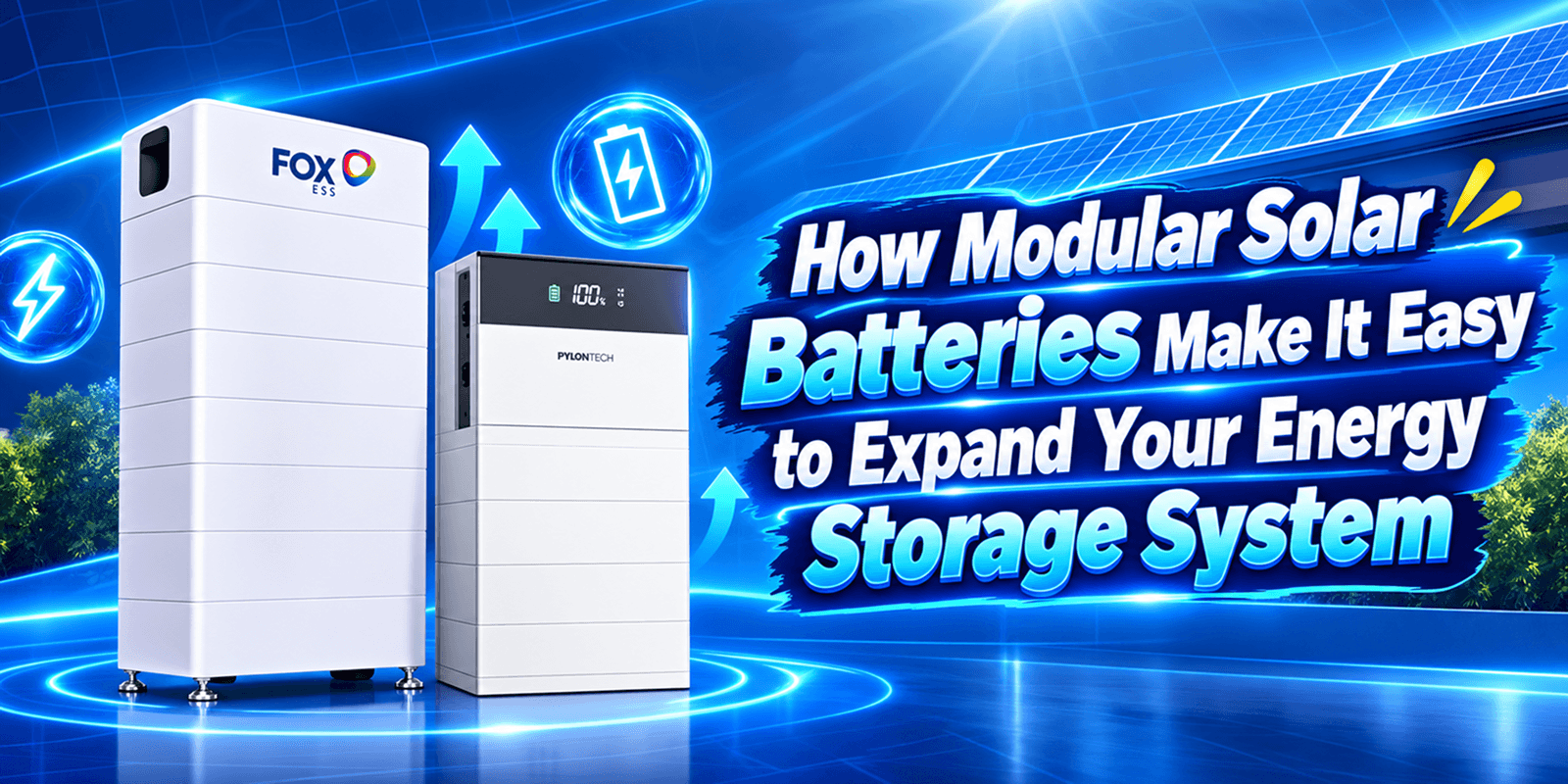
As solar projects become more diverse, energy storage requirements are becoming harder to predict. A residential customer may initially need a modest battery for self-consumption, while a growing business may later require significantly more storage to manage higher loads, backup requirements or changing energy-use patterns.
This is where modular battery storage can provide a practical advantage.
Instead of selecting one large battery system based entirely on future requirements that may not yet be known, modular systems can allow storage capacity to be built from individual battery modules. Depending on the manufacturer and system design, additional compatible modules can be added as energy requirements increase.
For solar installers and distributors, this approach can make system design more flexible while giving customers a clearer pathway for future expansion.
What Is a Modular Solar Battery?
A modular solar battery is an energy storage system made up of individual battery modules that can be combined to create the required storage capacity.
Rather than treating the battery as one fixed unit, the system can be configured using multiple compatible modules. The exact number of modules, connection method and maximum capacity depend on the battery manufacturer and the compatible inverter or energy management system.
Achievers Energy’s current battery range includes products from brands such as Pylontech, FoxESS, Growatt, SolaX Triple Power and Sungrow, along with GoodWe and other battery products available through its catalogue.
For example, Achievers Energy currently lists the Pylontech Force-H3, FoxESS EQ and CQ series, Growatt APX, SolaX Triple Power T58, and Sungrow SBH and SBR battery products. GoodWe also offers modular storage through its ESA platform. The available configurations and expansion options vary between products.
The main idea is simple:
Start with the storage capacity required today, while keeping a practical pathway for adding capacity later where the selected battery system supports expansion.
This can be particularly useful when the customer’s future electricity consumption is difficult to forecast.
Why Is Battery Scalability Important?
Energy requirements can change after a solar system is installed.
A homeowner might add an electric vehicle. A business could extend its operating hours or install additional equipment. A property may also move towards greater energy independence and require more stored energy during periods when solar generation is low.
If the original battery system cannot be expanded, increasing storage capacity may require replacing the existing system or installing an additional solution.
A scalable battery system can provide another option.
When the selected battery architecture supports expansion, additional modules can potentially be integrated into the existing storage system, subject to the manufacturer’s specifications and installation requirements.
This can help solar businesses design systems with both current requirements and future expansion in mind.
How Modular Battery Storage Works
The basic concept behind modular storage is straightforward.
A battery module provides a defined amount of energy storage. Multiple compatible modules can then be combined according to the manufacturer’s approved configuration.
The system may include:
- Battery modules
- Battery management system (BMS)
- Hybrid or battery inverter
- DC protection and isolation equipment
- Communications and monitoring
- Mounting or installation hardware
- Associated electrical equipment
The battery management system plays an important role in monitoring battery conditions and coordinating the operation of the connected modules.
However, modular does not mean that any battery can simply be added to any existing system. Compatibility is critical.
Installers need to confirm the approved battery configuration, inverter compatibility, communication requirements, voltage range, maximum number of modules and other manufacturer-specific requirements before expanding a system.
Modular Batteries vs Fixed-Capacity Storage
The difference becomes clearer when comparing a fixed-capacity system with a modular solution.
| Consideration | Fixed-capacity battery | Modular battery system |
|---|---|---|
| Initial sizing | Based on a fixed capacity | Built from compatible modules |
| Future expansion | May be limited | Available where supported by the product |
| System flexibility | Lower | Higher |
| Capacity planning | Greater focus on future needs | Can accommodate changing requirements |
| Installation | Depends on system design | Depends on module and stack configuration |
| Compatibility | Product-specific | Requires approved module and inverter combinations |
| Suitable applications | Predictable storage requirements | Projects with changing or uncertain requirements |
This does not mean modular storage is automatically the right choice for every project.
A fixed-capacity battery may be appropriate when energy requirements are well understood and the system does not need future expansion.
The right approach depends on the project, available equipment, customer requirements and manufacturer’s specifications.
The Benefits of Modular Battery Storage for Solar Installers
For installers and solar businesses, modular storage can provide several practical advantages.
1. More Flexible System Design
Modular batteries allow installers to select a storage configuration that better matches the customer’s current energy requirements.
Rather than automatically oversizing the battery, the system can be designed around actual consumption, available solar generation and the customer’s intended use.
2. Easier Capacity Expansion
One of the biggest advantages is the potential to increase storage capacity without redesigning the entire energy storage system.
If the original battery platform supports additional modules, the customer may be able to expand storage when their requirements change.
For example, the FoxESS EQ battery listed by Achievers Energy uses a master-and-slave modular architecture and can be configured with additional compatible modules according to the product specifications.
3. Better Planning for Changing Loads
Energy consumption is not always static.
For residential projects, future loads may include EV charging, electric hot water, heating and cooling or other appliances.
For commercial projects, additional equipment, longer operating hours or business expansion can increase electricity consumption.
A modular storage architecture can make it easier to plan for these changes.
4. Reduced Risk of Over-Sizing
Oversizing a battery at the initial installation stage can increase project costs without necessarily providing a corresponding benefit if the available solar generation or energy consumption does not justify the additional capacity.
Modular storage gives system designers another way to approach this decision.
The initial system can be sized around current requirements while allowing for future expansion where the product supports it.
Modular Storage and Renewable Energy Storage
The value of battery storage goes beyond simply increasing the amount of stored energy.
For solar systems, batteries can help shift energy generated during periods of solar production to periods when electricity is needed later.
For example, a solar system may generate significant energy during the middle of the day while the property’s electricity demand is relatively low. A compatible battery can store some of that energy for later use.
This can support applications such as:
- Increasing solar self-consumption
- Evening energy use
- Load management
- Backup power, where supported
- Reducing reliance on grid electricity
- Supporting changing energy-use patterns
The actual benefit depends on system design, battery capacity, inverter capability, electricity consumption and operating conditions.
For installers, this makes correct system sizing particularly important.
What Should Installers Check Before Expanding a Battery System?
Battery expansion should not be treated as simply adding another module to the installation.
Before recommending additional modules, installers should check the complete system.
Battery Compatibility
Confirm that the new module is compatible with the existing battery model and configuration.
Some manufacturers allow only specific modules to be combined, while others may specify limits on module quantity, configuration or system architecture.
Inverter Compatibility
The inverter must be capable of operating with the proposed battery configuration.
The inverter’s battery voltage range, charging and discharging limits, communication protocol and maximum supported battery capacity should all be checked.
Existing Battery Configuration
Installers should identify exactly which modules are already installed and how they are configured.
This is particularly important when dealing with an existing system that may have been installed several years earlier.
Available Capacity
Adding battery modules does not automatically mean the entire system can deliver more power.
Energy capacity and power capability are separate considerations. The inverter and battery system must be able to handle the intended charging and discharging requirements.
Manufacturer Requirements
Always check the latest manufacturer documentation before carrying out an expansion.
Requirements can differ significantly between battery platforms.
For example, the current Achievers Energy range includes modular systems from GoodWe, FoxESS, Growatt and Sungrow, but each uses its own module architecture and approved configurations.
How Modular Batteries Can Support Different Project Sizes
One of the useful characteristics of modular storage is its application across different project sizes.
Residential Solar
A household may start with a smaller storage requirement based on its current electricity consumption.
If energy use increases later, an expandable battery platform may provide a pathway for additional storage, subject to the product’s approved configuration.
Small Commercial Projects
Businesses often have more variable energy demand than residential properties.
A modular battery can give installers greater flexibility when designing storage around daytime solar production, evening demand and future changes to the site.
Larger Energy Storage Applications
Larger projects require more detailed engineering and system design. Multiple battery stacks or larger storage configurations may be possible with some platforms, but these must be designed according to the manufacturer’s specifications and the project’s electrical requirements.
This is where product selection and technical support become particularly important.
Why Battery and Inverter Compatibility Matters
A battery should not be selected independently from the rest of the energy system.
The battery, inverter and control system need to work together.
Compatibility can involve:
- DC voltage range
- Battery communication
- CAN or other communication interfaces
- Maximum charge current
- Maximum discharge current
- Number of supported battery modules
- Approved system configurations
- Firmware requirements
- Protection and isolation requirements
For solar installers, checking these details before ordering equipment can prevent avoidable installation problems.
It can also make future expansion easier when the original system has been designed with scalability in mind.
What About Solar Mounting Systems?
Battery storage is only one part of a complete solar installation.
The wider system may include solar panels, inverters, battery storage, electrical protection, cabling and solar mounting systems.
For installers and system designers, considering these components together can help create a more practical installation plan.
However, solar mounting systems serve a different function from battery storage. Mounting equipment supports and secures PV modules, while batteries store electrical energy.
The important connection is system planning.
When a project is being designed for future expansion, installers should consider available installation space, electrical infrastructure, equipment placement and the potential addition of other system components.
Achievers Energy’s current product categories include solar panels, inverters, mounting and electrical components alongside battery storage, allowing installers to source multiple parts of a solar project through the same wholesale distributor.
Modular Battery Storage Can Make Future Upgrades Simpler
One of the strongest reasons to consider modular storage is the uncertainty surrounding future energy requirements.
It is not always possible to know exactly how much energy a property will consume several years after installation.
A scalable battery platform provides an opportunity to respond to that change.
For example:
Initial installation → Current storage requirement → Increased energy consumption → Additional compatible battery modules → Expanded storage capacity
This approach can be particularly useful when the customer’s future plans are still developing.
However, expansion should always be considered during the initial system design rather than treated as an automatic guarantee.
Choosing Battery Storage Solutions for Future-Ready Solar Projects
For solar installers and retailers, battery selection is about more than choosing a certain number of kilowatt-hours.
The system needs to work with the inverter, electrical design, available solar generation and customer’s expected energy use.
A modular battery can provide additional flexibility because storage capacity may be expanded as requirements change.
Achievers Energy currently supplies battery storage products from brands including Pylontech, GoodWe, FoxESS, Growatt, SolaX Triple Power and Sungrow, giving solar businesses access to different battery platforms for different project requirements.
For businesses sourcing battery storage solutions, having access to different battery platforms can make it easier to match equipment to the technical and commercial requirements of each project.
Final Thoughts
Modular solar batteries provide a practical approach to renewable energy storage when energy requirements may change over time.
Instead of designing every project around a fixed future capacity, installers can consider systems that allow storage to grow with the customer’s needs, where the manufacturer supports expansion.
The key is proper system design.
Battery compatibility, inverter capacity, electrical requirements, installation space and manufacturer-approved configurations all need to be considered before an expansion is carried out.
For solar businesses, choosing scalable equipment at the beginning can create more flexibility for future projects and upgrades.
At Achievers Energy, installers and solar businesses can source solar batteries, inverters, panels, mounting and electrical products from a range of established brands, backed by wholesale supply and Australian-based technical support for solar projects.


